How to Allocate Your Marketing Budget Across Channels for Maximum ROI
It's an age-old question for Marketing, Growth & Finance teams. How do you allocate your budget across marketing channels?
Here at Linea, we recommend a three-step process to successfully achieve this
Measure➡️Marketing Goals➡️Scenarios
1. Cross-channel Allocation Measurement: You need MMM
Whilst here at Linea, we recommend aligning your business question with the right marketing measurement tool. The gold standard for cross-channel allocation is Marketing Mix Modelling (MMM). You can see a detailed overview of the right measurement tools for you.
The benefits of a well-built MMM model are two-fold:
1️⃣Measure ROI/ CPA on a like-for-like basis
2️⃣Understand the response to advertising at different spend levels. Known as diminishing returns curves.
The diminishing returns are the crucial aspect to support your cross-budget allocation. As a marketing channel that has a high ROI at a low spend may not be able to support scaling.
Within your MMM, as you are looking back over a 2-4 year period. You have the data points to better understand how differing daily/ weekly levels of spend respond. Typically, as can be seen in the interactive chart below, as spending increases, your advertising achieves fewer returns.
Why does efficiency typically reduce at higher spend levels? This is driven by the age-old terms of reach and frequency. More spending means that you are reaching a less targeted audience. Assuming you hit your target audience with your first £1. More spending will also mean that you are increasing the number of times you “hit” your target audience. As such, higher frequency can mean more waste.
How to measure diminishing returns? An Interactive chart
2. Define Your Marketing Goal: From Efficiency to Growth
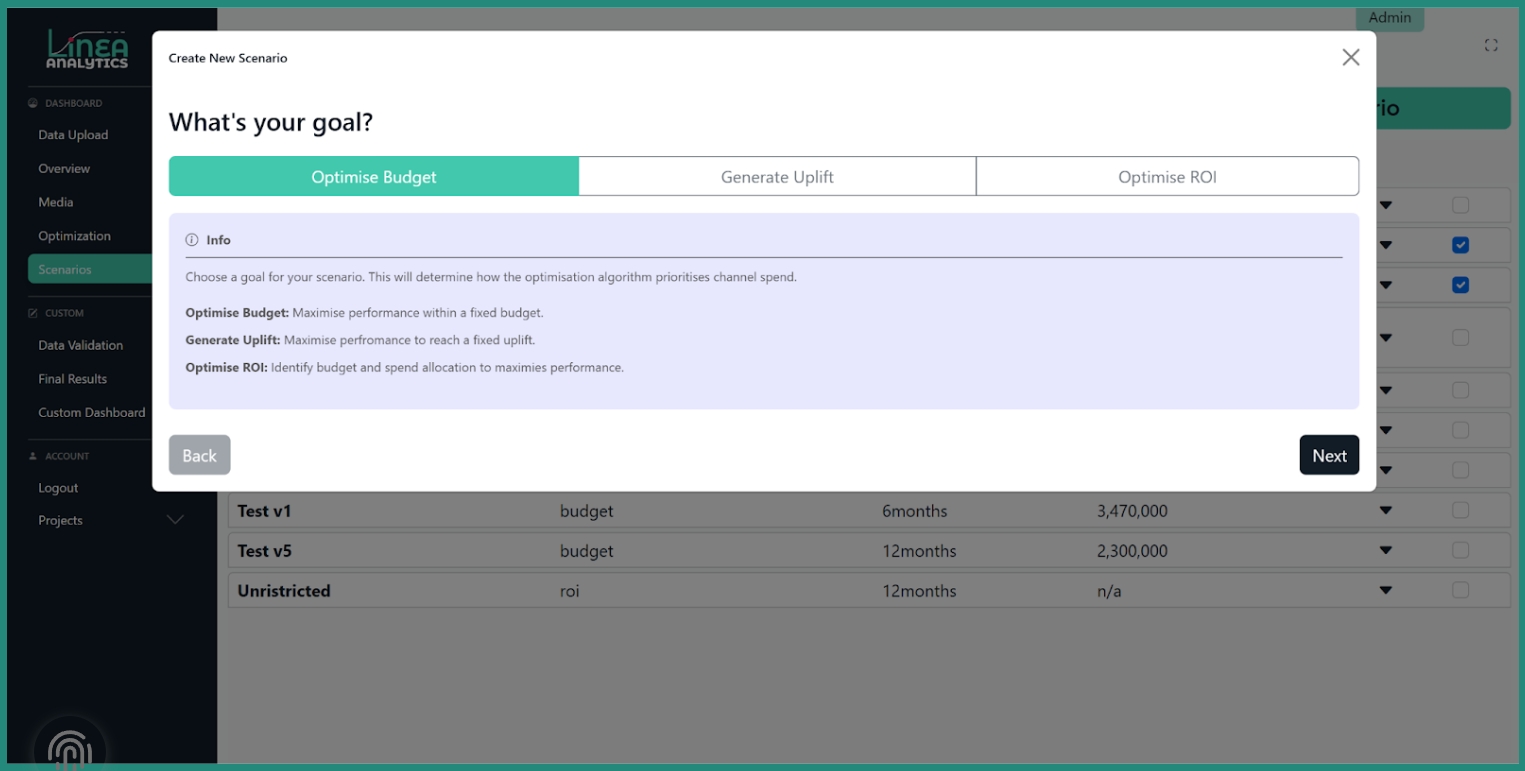
A one-size-fits-all approach to budget allocation simply doesn't work. Your marketing objectives change, and your measurement tools should be agile enough to change with them. Here at Linea, we have the Linea Scenario Tool.
This offers three core objectives to support any business goal:
- A Set Budget: Ideal for initial planning, this mode allows you to input a fixed budget and see the predicted return. It's the perfect way to draft an initial media budget allocation and forecast the level of returns your investment will deliver.
- A Target Uplift: When your focus is on aggressive growth, this option is your go-to. Instead of starting with a budget, you set a target for new customers or revenue. The tool then calculates the optimal spend and channel mix to hit or exceed your growth targets. This is crucial for answering questions like, "What extra customers can my marketing drive?"
- A Desired ROI Level: This feature is for brands focused on sustainable, profitable growth. You can optimise your media plan against a target ROI or CPA, ensuring every customer is acquired within a profitable range. It helps you identify exactly how much more you can spend while staying profitable.
3. What-If Factors: Improving the accuracy of your budget allocation
You have your Diminishing Returns Curves, and you have also set your marketing goal. The next step is to make it reflect what is going to happen in the future.
In our experience at Linea, Marketers should be presenting back a range of scenarios to their wider business. Let's consider two scenarios:
1️⃣Media cost inflation impact on budget allocation
This is a crucial factor. Many brands are currently (Q4 2025) seeing high inflation on digital platforms in particular on some key search terms & across Meta.
If you know that Search is going to be 10% more expensive, then effectiveness will reduce by 10%, unless you see a change in efficiency.
So when running a cross-budget allocation, if one channel's effectiveness is going to reduce, then more budget should be allocated to other channels. Try it for yourself below.
How to adjust your budget allocation for rising cost inflation? An Interactive chart
2️⃣External factors influencing Marketing performance
You are a subscription TV service, and you have some “big TV shows” about to launch
You are a FinTech focused on saving & interest rate is likely to go up next quarter
You are a Budget Retailer, and the economy is predicted to be weaker next quarter
In all of these examples, we see a common trend. Marketing effectiveness is different during periods of peak market demand or when your product quality changes. As such, your measurement should capture this synergy between marketing and external factors.
At Linea, we capture this synergy effect. This allows for an important overlay of how future economic or market performance will impact our budget allocation. The interactive chart below shows how, at a total budget level, an increase in the wider market or economy should have an impact on your budget & the amount of revenue you can expect to generate.
How do external factors impact your budget allocation?
That is exactly what we allow teams to run in the Linea Scenario Tool. Whether you have already run your MMM, use an open source tool or if Linea runs your MMM then this is exactly the type of future facing scenarios that allow you to confidently take action from measurement.