How to adapt marketing measurement as your business grows?
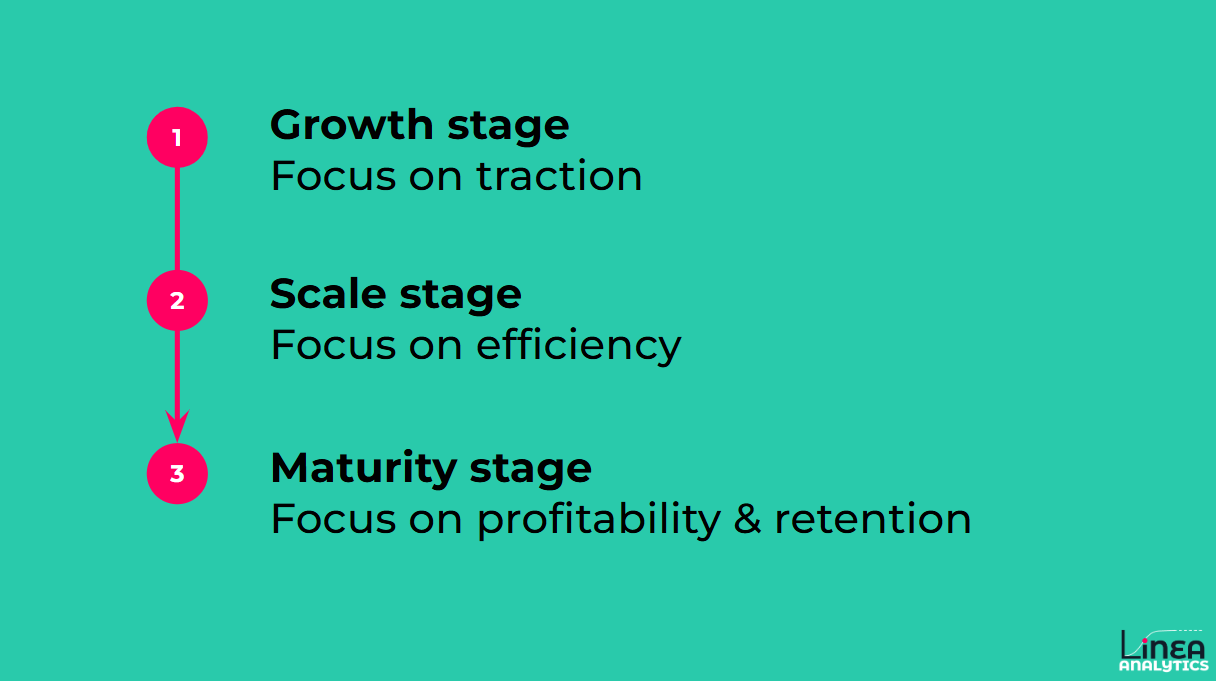
As a business evolves, the business objective of your marketing strategy inevitably shifts. What works for a startup fighting for its first thousand customers won’t suffice for a market leader defending its territory or optimising for the bottom line.
To maintain a competitive edge, leadership must adapt its measurement frameworks to match its current lifecycle stage.
This article explores how to transition your marketing metrics from initial traction to long-term profitability.
Marketing Measurement for Growth Companies: Focus on Traction
At this stage, the key focus is to drive traction and discover what specifically drives sales.
When identifying KPIs for growth companies, maximising customer acquisition volume is paramount. In addition, brands need to prove that each customer can be acquired within CAC/CPA targets. It is even more vital to demonstrate that you can continue to acquire customers at higher levels of media investment.
Key Questions for Growth-Stage Measurement:
- What's working to drive customers?
Solution: Measure channel incrementality via Tests
- Can we scale the budget in a marketing channel/ campaign?
Solution: Measure channel incrementality via Geo Test or MMM - see case study
Transitioning to Scale: Efficiency and Optimisation
At the scale phase, you know what works its now about going out to achieve it. The key focus shifts toward efficiency and ensuring that increased investment continues to drive high returns.
Demonstrating that you can maintain or improve your efficiency while significantly increasing your media spend is vital. It is no longer just about volume, but about finding the "sweet spot" of your marketing budget.
Key Questions for Scaling Businesses:
- How do we get more returns for the same budget?
Solution: Use cross-channel allocation to maximise returns from the same budget
- How should we allocate budgets based on our CPA/ ROI targets?
Solution: Set marketing budgets based on your goals. Want to drive 10,000 new customers in Q4 or hit a target ROI. These are the questions you should now be asking.
Maturity Phase: Marketing Measurement for Profitability
In the maturity phase, your marketing measurement matures toward profitability and retention. At this stage, the business must balance the immediate need for sales with the long-term value of the customer base.
Marketing is no longer just an acquisition engine; it is a tool for maximising the lifetime value (LTV) of every user and ensuring sustainable profit margins.
Key Questions for Mature Businesses:
- How do we run scenarios to maximise our ROI in the short & long term?
Solution: Use advanced MMM and predictive modelling to forecast the impact of different spend scenarios & when they will drive impact - see case study
- How does marketing influence new customers & retention?
Solution: Segment measurement to distinguish between the cost of acquiring new users and the ROI of re-engaging existing ones.
In summary
In summary, your marketing metrics, measurement tools, and strategic focus must evolve alongside your business goals. By proactively updating your KPIs for growth companies as you transition into scale and maturity, you ensure your marketing remains a value driver.
Measurement Evolution Table:
| Business Stage | Business Goal | KPI |
|---|---|---|
| Growth | Traction | Sales/ CAC |
| Scale | Efficiency | CPA/ ROI |
| Maturity | Profitability & retention | ROI |