Comparing Market Mix Modelling Agencies in the UK
I have heard many people use the phrase we aren’t comparing Apples with Apples. That is true in many industries from hotels, restaurants to the modern business vernacular.
This is no more so than the marketing industry and the world of Marketing Mix Modelling (MMM). In this industry we find that not all providers and approaches are created equal.
From traditional consultancy models to modern, "always on" platforms, the options can be overwhelming. As a measurement expert at Linea Analytics, I’ve seen how the right partner can transform marketing and drive a 30% increase in marketing ROI.
But what is the right partner?
The 4 types of Marketing MMM provider?
1. Modern "Always On" Providers (The Linea Model)
These providers combine the automation of software with the expertise of consultants to drive updates at the speed of last Click.
- Pros: Fast, cost-efficient, and transparent; built for continuous decision-making.
- Cons: Requires a commitment to data connectivity for maximum value.
2. Traditional Providers: Marketing Mix Modelling Consultancy
These traditional providers deliver a high-touch service but often operate on a "black box" basis with long lead times.
- Pros: Choosing the right marketing mix modelling consultancy is vital for brands needing deep strategic advice and industry benchmarks
- Cons: Traditionally they are seen as slow and expensive. With results being seen as out-of-date by the time they are delivered.
At Linea we offer Full service MMM. This allows us to provide the speed of Modern MMM combined with the consultancy expertise to embed MMM in your organisation
3. Media-Only Providers (The Platform Views)
There are many .
- Pros: Often lower cost; easy data access.
- Cons: Potential for bias (measuring their own homework); often lacks a holistic view of external factors like price or economy.
4. Open Source (The DIY Approach)
Tools like Meta’s Robyn or Google’s Meridian allow data science teams to build models internally.
- Pros: Free software; full control over the code.
- Cons: Requires heavy data science resources; often misses "marketing context," leading to undervalued mid-funnel activity or overestimated search impact.
- Cons: Whilst the open source providers may seem like a long term reliable partner. Teams need to make sure these open source tools are updated. For example, at time of writing (March 2026) Robyn hasn’t been updated for 9 months & Google Meridian for 2 weeks.
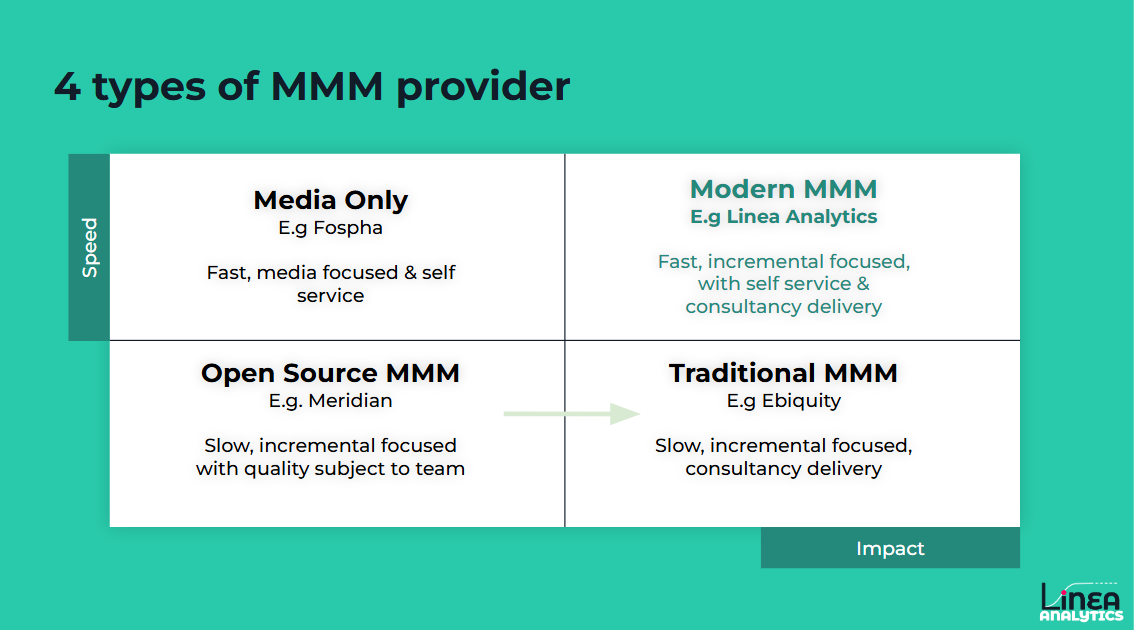
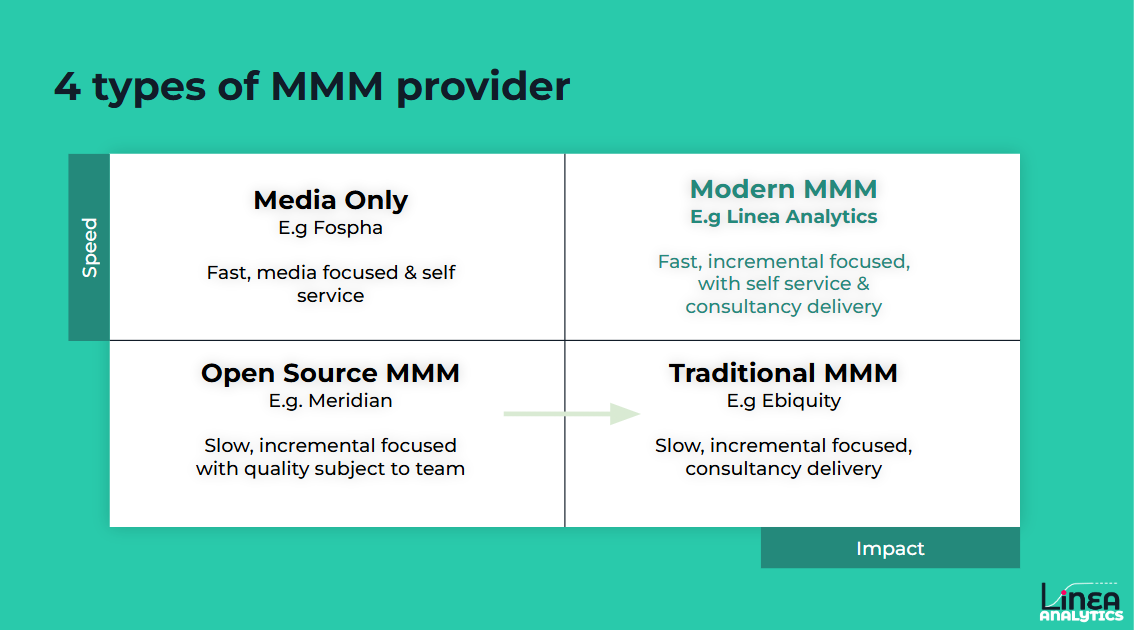
Marketing Mix Modelling Providers: Speed vs. Impact
The below image demonstrates where each of the 4 types of providers sit on an axis of Speed vs. Impact. This is a generalised view but demonstrates how:
- Modern MMM and Media only providers focus on speed
- Modern MMM & Traditional providers typically deliver the most impact
- Open source users typically show the most variation in this dynamic
- In my experience the speed is often conducted at a slower rate
- The impact of these tools can vary. With some internal teams using integration to drive high levels of impact
Why Not All MMM Tools Are the Same
Before we get into the details on what the best approach is and when we should use them. I want to highlight a buyers note:
Not all MMM Tools are the same
There are a variety of so-called automated MMM tools. These include Adobe MMM, Triple Whale, Fospha, amongst others. The challenge for buyers or users of these tools is to ensure that they capture all drivers of sales.
Whilst they may use statistical approaches, they also need to include the following factors:
✅All digital media channels (normally included)
? Offline marketing channels (sometimes included)
❌Long-term impact of media (not typically included)
✅Seasonal factors (often included)
? Impact of external factors e.g. market or economic drivers
❌Price, product & promotional changes
❌Synergy impact between Media drivers & External factors (e.g.promotions)
All too often, models don’t take into account many of these key relationships. This creates lower quality and, most importantly, less action can be taken from your MMM.
Comparing the 4 types of MMM providers
| Modern MMM Linea Always-on MMM | Traditional MMM Providers E.g. Ebiquity | Media Only “MMM” E.g. Fospha | Open source MMM E.g. Meridian | ||
|---|---|---|---|---|---|
| Measure Omnichannel (DTC, Partners [amazon], In-Store) | ✅ | ✅ | x | ✅ | |
| Impact of price changes, promotions and product | ✅ | ✅ | x | ? | |
| Measure Marketing incrementality | ✅ | ✅ | x | ✅ | |
| Fast data access with APIs | ✅ | x | ✅ | x | |
| Time to Results | Live | 8-12weeks | Live | 8-12weeks | |
| Transparent Access | ✅ | x | ? | ✅ | |
| Experts to help you take action from measurement | ✅ | ✅ | x | x | |
| Tools to take action | ✅ | x | ✅ | x |
What MMM is Right for Me?
Answer these questions to identify your ideal measurement path:
- How quickly do you need to make budget decisions?
- A) Quarterly or Yearly (Traditional)
- B) Monthly or Weekly (Modern / Always On)
- Do you have an in-house data science team with available resources and experience with MMM?
- Yes (Open Source / Modern)
- No (Traditional / Modern)
- What is your primary goal?
- A) High-level board reporting (Traditional)
- B) Daily/Weekly tactical optimisation (Modern)
- Is your data currently centralised and clean?
- Yes (Open Source/ Modern/ Traditional)
- No, I need help with connectivity (Modern/ Traditional)
What should MMM buyers focus on in 2026?
As we look toward 2026, below are 4 trends for MMM buyers to keep in mind:
- Is it available at the right moments?
The importance of speed of updates has never been more relevant. Getting to an Always-on MMM has never been higher. Typically, MMM has been seen as slow and backwards-looking. But more than ever, brands want to use incremental focused MMM not just to allocate quarterly or annual budgets but to set optimal daily or weekly in-channel budgets.
- Is it a Black Box, and can I own it?
Transparency sits at the heart of buyers decision making. That could be building in your own environment or getting full access to model parameters. This builds confidence in the accuracy of models and ensures the outputs are trusted.
- Cost
The price of either internal data science teams or platform costs remains important, with prices varying subject to the number of models, markets & frequency of updates. Historically, MMM has been seen as expensive, but modern platforms can provide more cost-effective options. A successful implementation with action taken will drive significant commercial value.
- Take action from MMM.
Taking action from MMM is often not a technical challenge but an ability to take stakeholders on a journey from current measurement to incremental & cross channel measurement. Access to the right information, knowledge & tools to drive implementation ensures that brands can take action from MMM.
Why Linea Analytics?
As a leading marketing mix modelling consultancy and market mix modelling agency in the UK Linea Analytics provides the 'Modern' approach to measurement".
We firmly believe that brands of all sizes deserve trusted measurement without the traditional wait times of Marketing Mix Modelling.
We occupy the "Modern" space by delivering on three core promises:
- Faster through Always On MMM: We use a 6-point automation scale to streamline data connectivity and model updates. This significantly improves time-to-action compared to manual providers.
- More Transparent: We don't believe in "black boxes." We bridge the gap between data science and marketing, ensuring your team understands and trusts the "why" behind the results.
- Run Scenarios & Take Action: Our tools aren't just reports; we have built our solutions to drive growth for your business.
Ready to move beyond last-click and embrace true incrementality?
Let’s build your measurement roadmap together.